
In a rare break for the Institute’s scientific method — “test first, ask questions later” — one particularly long-running study has been discovered to have a timeline stretching theoretically farther into the past than the concept of time can account for.
For decades, Study #00734-C was considered “ongoing but non-urgent”: a longitudinal observation of controlled salt crystal growth in stable humidity, housed in a little-traveled laboratory annex adjacent to the Department of Theoretical Processes.
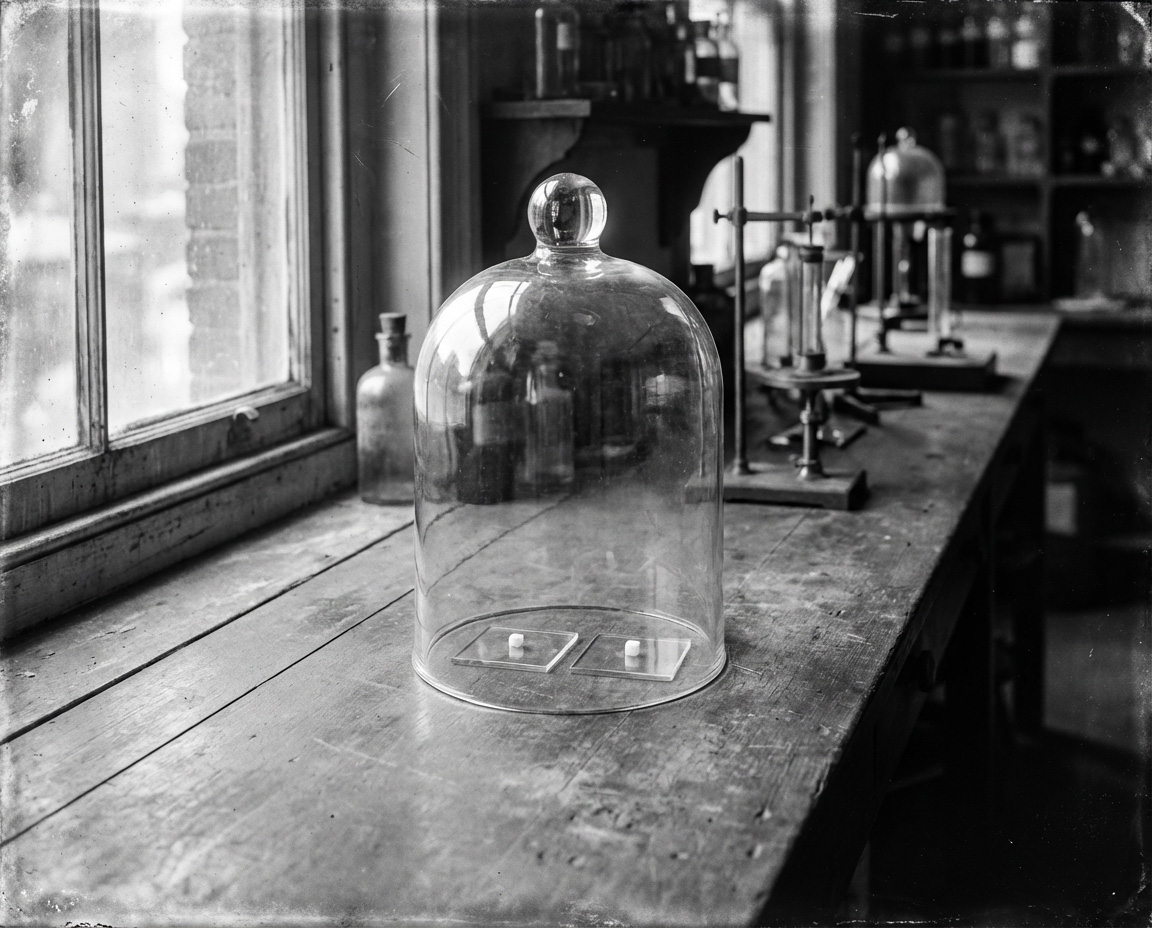
Initiated in late 1902 by Dr. Prof. Walter J. Bullock, one of the Institute’s founding scienticians, the study was titled “A Modest Inquiry into the Patience of Matter.” It consisted of a sealed bell jar containing two matched salt grains on parallel glass plates. Weekly observations were originally logged by hand, then typewritten, then filed by punch card, and finally logged digitally in the Institute’s purpose-built CMS.
For nearly a century, nothing of note occurred. This was seen as ideal.

In 1999, during a routine audit of neglected projects and incomplete expense reports, Junior Archivist Leigh Gantry noticed an anomaly while comparing the different formats of metadata for Study #00734-C:
In Dr. Prof. Bullock’s original notes, the study was scheduled for completion following 100 years of observation, in 2002. Carbon paper archives from the early jazz age placed the end date in 1946. Punch cards from the mid-50s had it in 1813. And in each successive computer operating system the Institute has used, the date the study would be finished moved exponentially further back in time. 1626 in 1978, 1402 in 1989, 602 this past spring. It’s speeding up, but backwards.
—Leigh Gantry, On the Regression of Lab Time, 1999
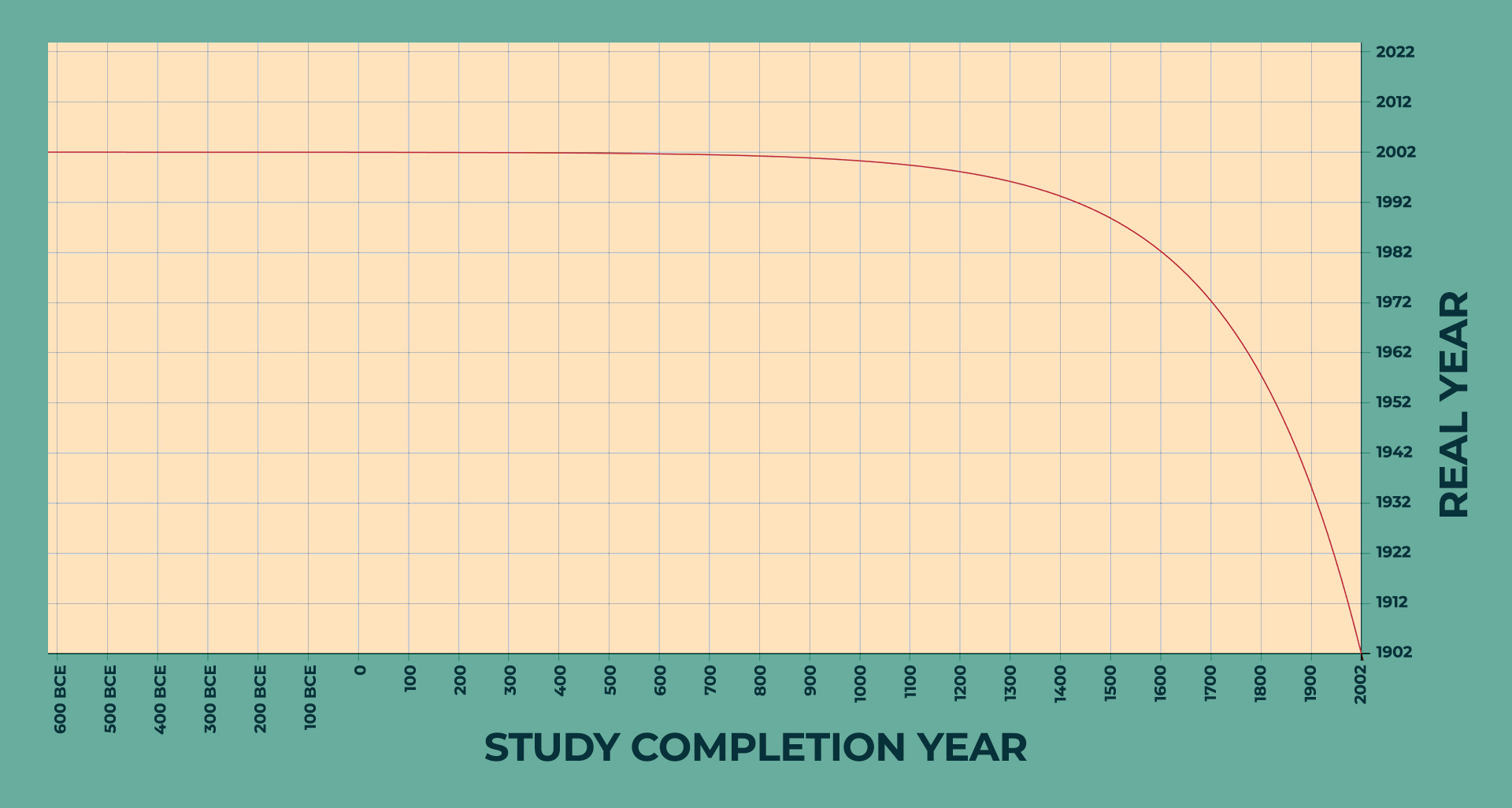
Gantry was immediately placed at the head of a special taskforce to quantify this phenomenon. Time was (or was to have been) of the essence.
Her investigation revealed the following:
- All observational notes were completed on-time and at regular intervals, per Dr. Prof. Bullock’s instruction. All scienticians involved in these notes, however, are no longer with the Institute, and cannot be contacted.
- The study room, when entered, created a kind of time-sink. Technicians routinely forgot why they entered the room and left several hours later having done something totally unrelated but nevertheless wholly engrossing.
- All attempts to remove the bell jar while wearing time-sensitive PPE resulted in staff members having returned to their desks exactly 11 minutes before they left. (Propositions made to use this anomaly to improve workday efficiency were rejected.)
Despite best intentions, the following were not revealed:
- Whether the study is still in progress.
- Whether it ever began.
- Whether those are different questions.
Gantry’s recommendation was thus: “We should neither conclude the study, nor interfere with its conclusion. It may conclude us, if appropriate.” In the time it took to complete the six-month assessment, the study’s end date had crossed into the triassic era.
A raft of Dr. Prof. Bullock’s lab notes, previously presumed missing, were recently discovered buried in the Smythe Memorial Peat Bog during construction of the Institute’s new bowling alley. To the surprise of all involved, an experiment of this noteworthiness took up little real estate in his journals:
I wished only to see if stillness could yield structure. The crystals are firmly rooted in time and space. Instead, I have become uncertain about when I am.
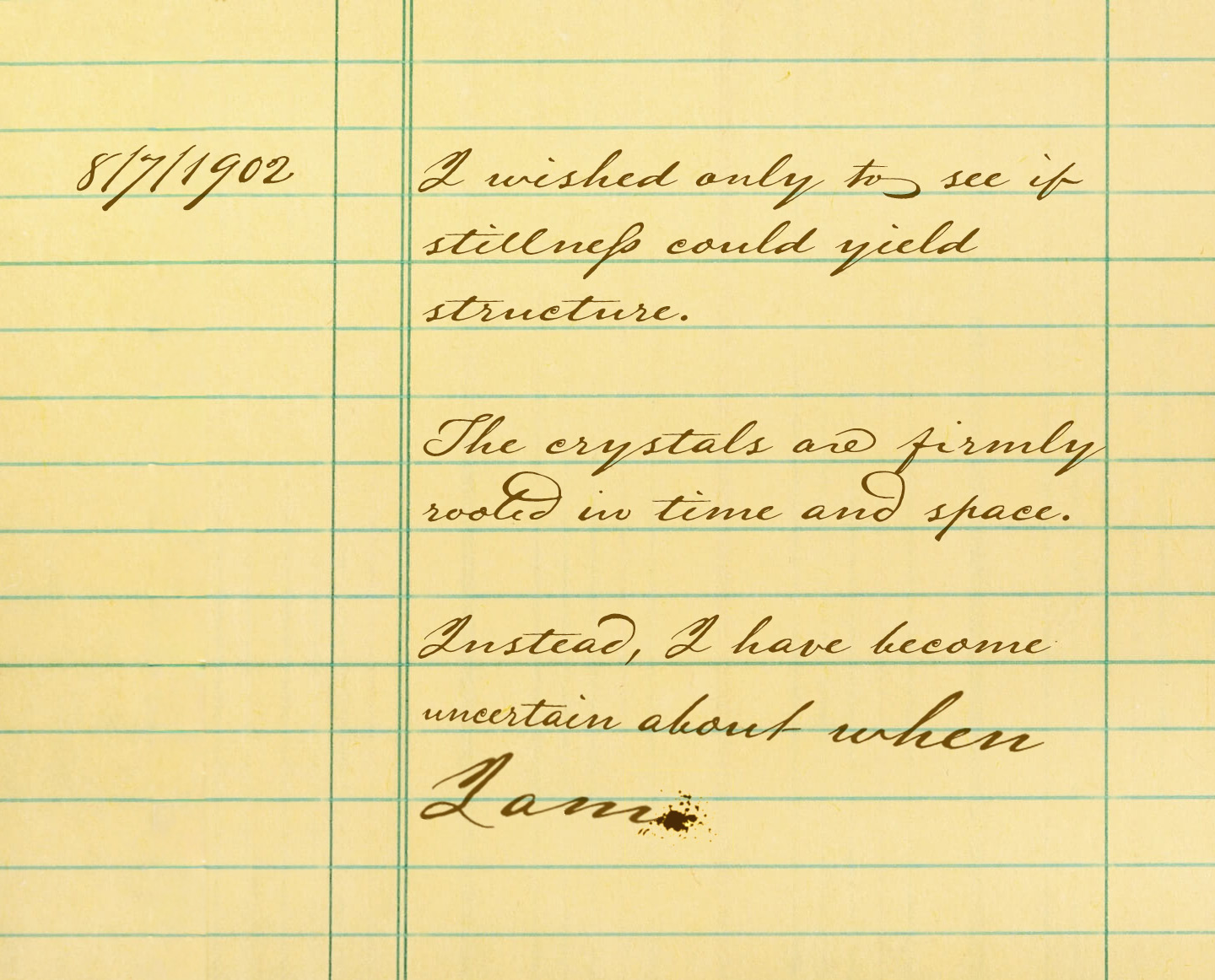
Dr. Prof. Bullock sadly disappeared shortly after this entry. He is memorialized in Courtyard E with a small bench plaque.
“We are not suggesting the study is eternal,” said Dr. Melis Vrain, Interim Chair of Continuity in 2001, when the study’s end date was before the formation of the Earth, “only that its duration cannot be meaningfully compared to anything outside of it.”
In early 2003, when the study’s end date was such a large number followed by “BCE” that it caused integer overflow errors in the Institute’s databases, the experiment was simply updated to “Undefined (time-resistant)”.
It should be noted that although the length of the study has receded so far into the past it may come back around again, phenomena associated with proximity to the bell jar continues to be stable, occurring only in the room in which it is kept, next to the vending machines.
Marcus Thornwood, Director of Communications for the Institute
Compiled from the Institute’s archives