
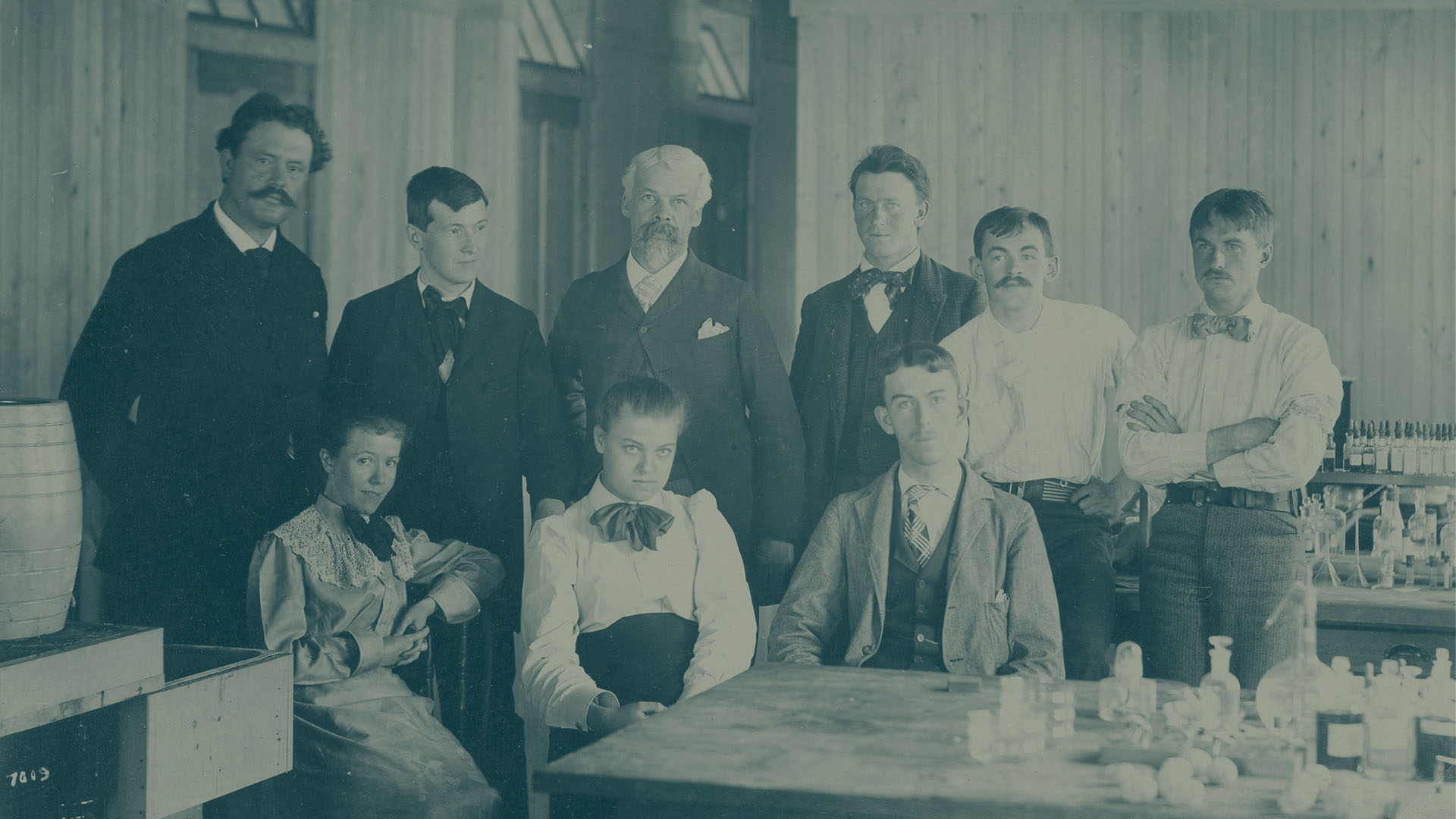
1901
Sciencing in the 20th century
Humble Beginnings
Belgian scientician Dr. Prof. Magda Hesketh-Dorleac moved to sunny San Diego, California, at the turn of the last century. It was there, in a drafty Spanish mission-style building overlooking La Jolla Shores, that she founded the Institute for Gravitronomic Inertiametrics. Her mission was simple:
To understand the universe and how it is different form the other ones.
1901 was a time when science was ready to learn more about the Universe. What does it look like? Does it have a taste? Does it exist on the back of a tortoise? Can it fit inside a breadbox, given a large enough breadbox? Is it really so strange or are we just paranoid?
1912
The Universe Is Discovered
A Place for Everything
After eleven years of theoretical supposition, diagrammatic gesturing, and speculative shrugs, the Institute for Gravitronomic Inertiametrics officially located the Universe in late spring of 1912. It was discovered — intact, unscathed, and modestly labeled — in a smallish wooden box behind a cabinet in Sub‑Basement B.
Upon opening the box, staff were momentarily enveloped in a mild but total sensation of infinite space. Several interns briefly collapsed into ecstatic awe. Others reported the distinct aroma of lilac, wet stone, and iron filings.
A formal declaration was made the following week:
The Universe, long hypothesized, has been found. It fits comfortably within known parameters and will be available for demonstration on Thursdays.
To prevent unauthorized replication, the box was returned to storage and fitted with a combination lock (code lost in 1931, found again in 1973, re-lost in 1989, and currently presumed hypothetical).
This marked the beginning of the Institute’s Post-Discovery Era, which continues to the present day.
1933
The Invention of Reverse Time
The Institute Gets Ahead of Itself
While working to refine a method of “clockfolding” (a process originally developed to fit more hours into the workday), Dr. Eglantine Braxley invented reverse time.
This was initially considered to be a scheduling breakthrough: meetings could now be held in retrosequence, with conclusions drawn first and attendance rendered optional.
Unfortunately, it proved difficult to prevent causality from unraveling. The Institute still holds a standing order that any staff member accidentally born in reverse time must be laid off before they apply.
“Several weeks ago, I will have rescinded my own promotion.”
—Selection from Dr. Braxley’s resignation letter.
The Department of Temporal Conduct was established shortly thereafter. Or will be, depending on when you read this.
1942
The Levers Are Thrown
Turning on Science
As global conflict escalated and scientific institutions were pressed into service, the Institute for Gravitronomic Inertiametrics launched its most ambitious wartime initiative: Project Fulcrum.
The project’s goal was straightforward but not well understood: determine what happens when all the levers are finally thrown.
Housed in a reinforced chamber beneath the Administrative Rotunda, the Control Array, also known simply as The Panel, was a vast, purpose-built interface of toggles, dials, pressure indicators, and a fully functional stovetop.
Institute staff, supported by visiting dignitaries, speculative engineers, and at least one dentist assembled to observe the Ceremonial Engagement of the Levers.
At exactly 14:00 on May 8, 1942, all levers were thrown in sequence. The room grew noticeably warmer. Several gauges spun and stopped. A distant tone was heard.
Nothing else occurred.
“To this day, no one is certain what was turned on, only that it cannot be turned off.”
—Dr. Helmut Corf, who pulled the levers
Official documentation described the outcome as “confirmatory, if not conclusive.” The panel was preserved and continues to function at idle.
1958
The Sky Is Confirmed to Be Up
Things Are Looking Up for Science
In response to growing international interest in outer space, the Institute launched its first independently verified directional confirmation experiment. The goal: to determine, once and for all, which way space was.
A tall ladder was constructed in the western courtyard. Over the course of three weeks, multiple intrepid scienticians clad in protective spacesuits climbed it and pointed in all known directions. The results were clear: the sky was, definitively, up.
“There was disagreement about whether it was directly up or slightly off to the left, but this was resolved by simply tilting the ladder.”
—Dr. Brent Ricotta, project lead
The Institute marked the event with a modest plaque, the reward for the finding of which is now considerable, that read simply:
SKY
Confirmed 1958
1964
The Institute Moves to Its New Campus
Concrete, Glass, Possibility
In 1964, amid growing interest in mid-century futurism, anti-gravity, and poured concrete slabs, the Institute for Gravitronomic Inertiametrics officially relocated from its original La Jolla facility to a bold new campus built on the remains of the original site: a sprawling modernist complex of cantilevered courtyards, curtain glass walls, and ominously unlabeled doors.
“At last, we have a home that reflects the scale of our ambition, the depths of our research, and the scope of our confusion.”
—Dr. Parnassus Weems, director of aesthetics
The old mission-style building was ceremonially folded in half and buried beneath the foundation of the new archive tower. There it remains — not haunted, but deeply foreboding.
1968
Vaults Are Built to House the Eggs
Egg
Following a series of synchronized subterranean vibrations detected beneath three unconnected Institute field stations, a survey team drilling near the eastern perimeter of Courtyard B struck an object shaped like an egg, but decidedly not an egg.
Within hours, eleven more were located at precise three-meter intervals along a shallow subterranean arc. Each was eggshell in both color and finish. None showed signs of decay, origin, or intent.
They were not warm, but they were also not cold enough.
“They are not organic. But neither are they mechanical. They are, in every measurable way, almost something. We respect their decision to not yet be anything.”
—Dr. Selwyn Parp, director of containment design
The objects, now formally catalogued as Eggs Alpha through Lima (inclusive), remain unaltered and in subterranean storage. They are monitored daily, wiped down weekly, and very politely not discussed.
The vault doors bear no markings beyond a small metal disc embossed with the word:
SOON
A staff lounge was added in 1993, though it is rarely used.
1971
The Merging of the Institute with Itself
Holding a Mirror to Science
As the Institute entered its eighth decade, and its first year without a member of the Hesketh-Dorleac family as director, budgetary confusion and multiple unsynchronized timelines caused the Institute to accidentally file for merger, with itself.
The result was the creation of The Other Institute for Gravitronomic Inertiametrics, which operated in an identical facility with an identical staff and charter, 14 feet to the west.
For 11 years, the two Institutes competed for grants, interns, and hallway space, until a freak elevator accident caused simultaneous re-entry into the same dimension.
Scienticians refer to this era as the time of the Insti2te
1989
The Institute Achieves Partial Transparency
The Institute Loses Sight of Itself
During routine maintenance on the Department of Subvisual Analytics’ refractometric mainframe, a calibration error in the Intra-Ocular Inversion Array caused the western third of the Schwaldenheimer Wing to become visibly uncertain.
Walls became slightly translucent. Desks grew vague. Several researchers were declared “partially implied.”
“It was not invisibility, per se. It was more a suspension of surface conviction.”
—Arturo Feng, director of stability
The effect, later classified as phenomenological semi-abeyance, was accompanied by mild headaches, inconsistent reflections in mirrors, and a notable drop in hallway collisions (as all movement was slowed to a ceremonial caution).
Despite attempts to reverse the effect, a 12-meter stretch of corridor remains optically incomplete. It is currently used for contemplative walks or to reflect on emotionally unstable theories.
1994
Confirmation of the Absence of a Fifth Fundamental Force
Nothing to Discover (In This Case, a Good Thing)
Following decades of quiet speculation, the Institute announced that the elusive Fifth Fundamental Force, long suspected to govern charisma, déjà vu, or the price of cantaloupe, does not exist.
The breakthrough came not through discovery, but through sustained non-detection. Using the Institute’s newly refurbished Null Array, scienticians conducted a three-year observation of absolutely nothing happening.
A monument was erected in the breakroom to honor the discovery of absence.
“We waited patiently. At no point did the Fifth Force manifest. That in itself is significant.”
—Prof. Wendy Palmaroni, lead researcher
To ensure rigor, the control group was exposed to the four known forces (gravity, electromagnetism, wind, dread) while the test group was exposed to a quiet room and a sense of vague expectation.
No difference was observed. This was seen as confirmation.
2007
The Discovery of Indoor Weather
Nice Weather We’re Having
A clogged ventilation duct, a miscalibrated air compressor, and a surplus of dry ice left over from the office Halloween party led to the first officially documented instance of sustained interior weather.
During initial research, meteorological conditions within the Institute’s R&D Department were found to fluctuate hourly. Observations included fogbanks over the copier, hail in the kitchenette, and a brief atmospheric river incident in the men’s restroom.
Rather than fix the malfunction, the Institute elected to preserve it as a research environment.
Today, the Internal Weather Observatory is one of the few known indoor climates with a resident bird species, the non-outdoor heron (ardea domestica).
Whether the weather is hot,
Whether the weather’s indoors,
We’re all off better
Researching the weather
Whether it interests or bores
Tour groups are advised not to enter without a jacket and an open mind.